
Not finding what you're looking for?
Contact UsSimple vs Compound Keywords
ExplanationKeywords in Messijo come in two flavors: simple and compound. Knowing when to use each makes the difference between clean, relevant matches and a dashboard full of noise.
Simple keywords
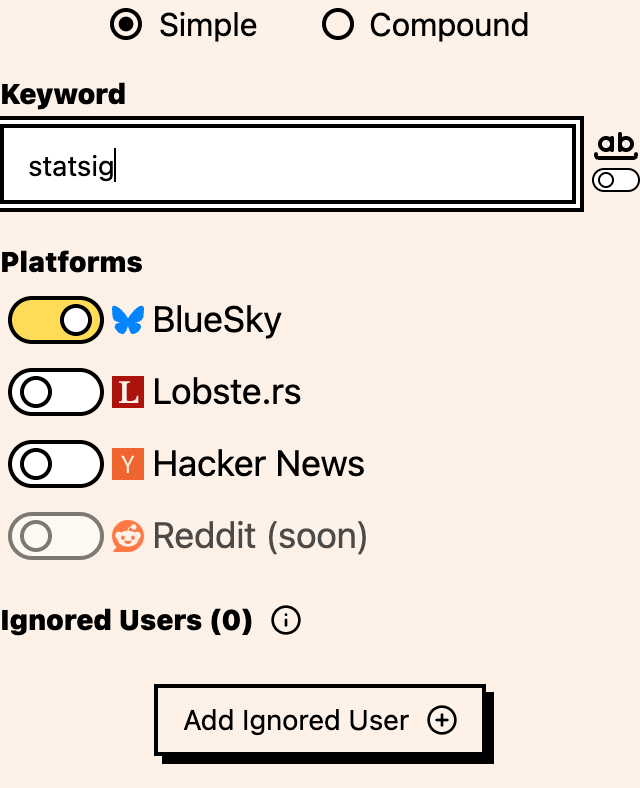
A simple keyword is a single word or phrase. When any post on your monitored platforms contains that word or phrase, it counts as a match.
Examples:
acme: matches any post containing “acme”product launch: matches any post containing “product launch”roadrunner: matches any post containing “roadrunner”
Simple keywords work well when the term is unique enough that you don’t get buried in false positives, or when you want broad coverage of a topic.
Compound keywords
Compound keywords combine multiple terms with AND and NOT logic, so you can create more precise matching rules.
AND logic
Use AND to require multiple terms in the same post:
acme AND competitorThis only matches posts that contain both “acme” and “competitor.” A post mentioning “acme tools” alone won’t match, but “acme is better than the competitor” will.
NOT logic
Use NOT to exclude posts containing a specific term:
acme NOT roadrunnerThis matches posts that contain “acme” but not “roadrunner.” Useful when your keyword also appears in an unrelated context.
Combining AND and NOT
You can chain both for maximum precision:
apple AND iphone NOT fruitThis matches posts containing both “apple” and “iphone” while excluding any that also mention “fruit.”
When compound keywords earn their keep
-
Your simple keyword is too broad. “Apple” matches the company, the fruit, and everything in between.
"apple AND iphone"narrows it to the context you care about. -
You want to exclude a recurring false positive. If “acme” keeps matching posts about Acme Roadrunner cartoons, use
"acme NOT roadrunner". -
You need context-specific matching. Create separate keywords for each combination you want to track. There’s no OR operator, so
acme AND competitorandacme AND alternativeneed to be two separate keywords. -
You’re tracking specific product mentions. Same idea:
messijo AND reviewas one keyword,messijo AND tutorialas another. OR logic isn’t supported, so each combination is its own keyword.
When to stick with simple keywords
- The term is already specific. If your brand name is unique (like “Messijo”), a simple keyword is fine.
- You want maximum coverage. Compound keywords filter out more results, which isn’t always what you want.
- You’re just starting out. Get comfortable with simple keywords first, then add compound logic once you see what noise patterns emerge.
Practical advice
- Watch what simple keywords match for a few days before adding compound logic. You need to know what the noise looks like before you can filter it.
- Use NOT sparingly. Each NOT condition risks filtering out relevant posts, so only add one when you have a specific, recurring false positive.
- Multiple keywords are better than one complex compound. Instead of building an elaborate compound keyword, create separate keywords for different contexts.
- A term might be noisy on one platform but fine on another. Adjust platform selection per keyword rather than over-constraining the keyword itself.
Where to go next
- Whole-word matching: control exact vs partial matches
- Ignoring users: filter out noise from specific accounts
- Per-platform setup: choose platforms per keyword